
Solutions — Supplement & nutrition retail
Supplement store software, built in a supplement store.
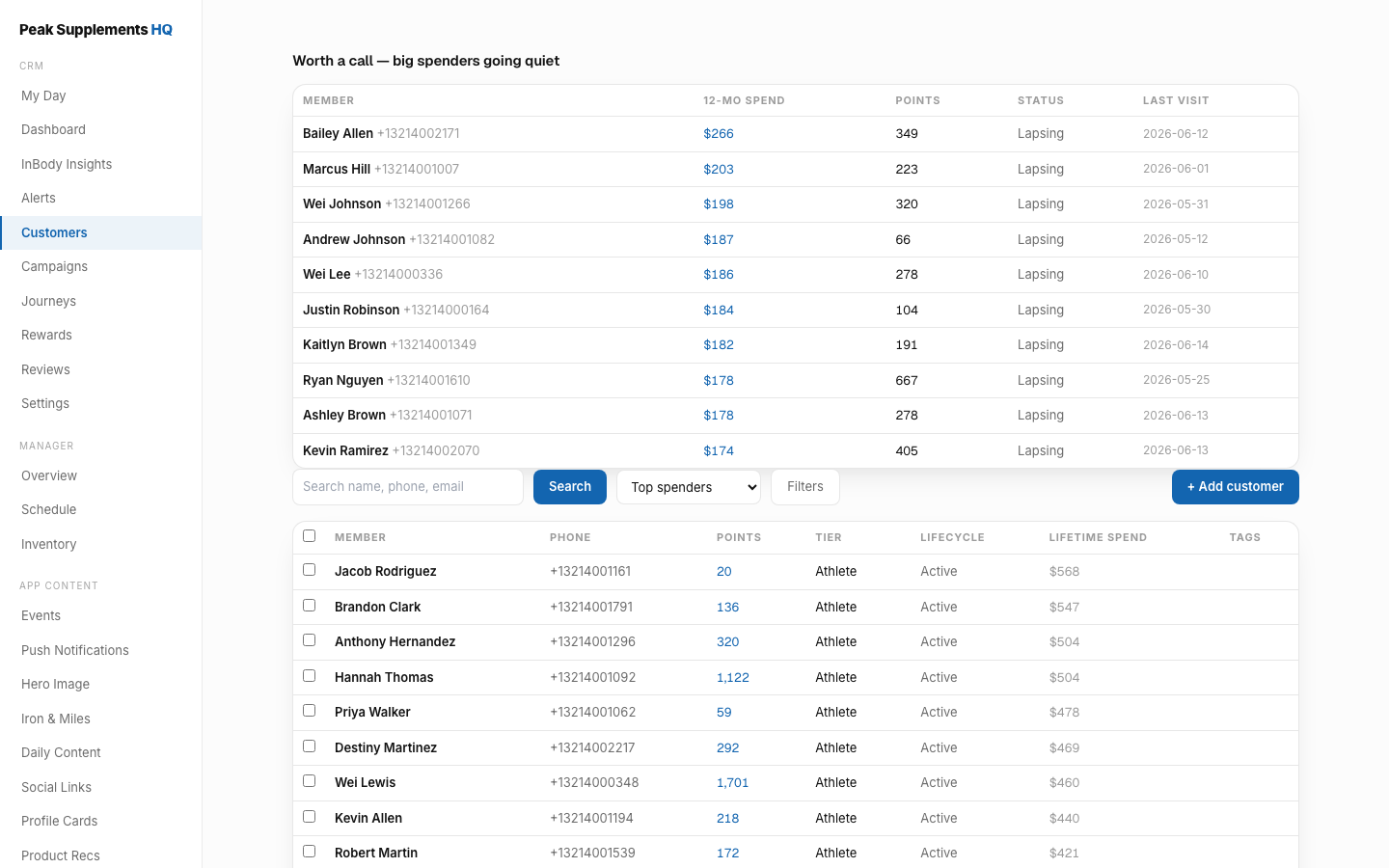
This is the vertical everything else grew out of. Loyalty, an iPad check-in kiosk, texting that survives the carriers, lifecycle segments, a rewards catalog priced against your margins, scan programs, and a member app — all under your brand, all on one member record. Every screen on this page is something running in a real store right now.
$200/mo · 5,000 texts included · $500 one-time setup & migration · no contracts
01 — The core
Points, capture, consent
A supplement loyalty program fails in one of three places: nobody earns, nobody checks in, or you cannot legally text the list you built. These four pieces are the fix, and each has its own page.
- The loyalty enginePoints per dollar, tiers with multipliers, and earn rules you can shape around reorder cycles instead of a generic punch card. How the loyalty engine works.
- Kiosk check-in on the counterAn iPad your members tap in on themselves: points balance, redeemable rewards, and an SMS opt-in checkbox recorded with source and timestamp. Ten seconds, zero staff data entry. See the founding store's live kiosk.
- Texting with the compliance doneDrip sending, quiet hours, opt-out handling, and A2P 10DLC registration filed for you by name. SMS marketing, and the A2P guide if you want to understand what carriers actually check.
- A rewards catalog you can affordThreshold rewards priced against your margins — dollar-off, free item, free product — redeemable at the kiosk or at the register. The rewards catalog.
02 — At the register
Points that land without anyone remembering to do it
The single biggest reason loyalty programs stall is that earning depends on a human step. Shopify POS sync removes it: the app installs in one click through Shopify's own OAuth, every paid order awards points automatically, and redemptions come back as discount codes in checkout. Name and email edits made in the member app mirror back into Shopify's customer record, so your POS does not drift from your CRM.
Clover is live as well. An OAuth connection plus a webhook means a Clover payment posts points the same way a Shopify order does, and applying a reward pushes a discount onto the open order at the register — a dollar-off reward as a discount, a free item discounted on its own line so a second one still rings up at full price. A Clover register app is built and submitted to the Clover App Market; until Clover finishes its production review, the web path is what you run.
Lightspeed R-Series works the same way from the other direction: a Rewards button on the sale tab launches the rewards screen with the live ticket attached, and each reward maps to a discount you already defined in Lightspeed, so your own reporting stays intact. It is our newest POS integration, so we connect the account and map the rewards with you rather than handing over a setup doc. Every integration is listed on the integrations page.
03 — Who to text, and when
Segments that know your stores apart
Lifecycle stages — new, active, lapsing, lost — are computed from real visit and purchase behavior, not from a tag someone forgot to remove. That is what makes a win-back fire at the right moment instead of three months late: how segmentation works, and the segments we actually use in our own stores.
Multi-location is where most loyalty tools quietly break. Here every member carries a home location plus a visit rollup per store, so a campaign can target their store — one send per member, no duplicates — or everyone who has ever walked into a given store, which deliberately catches the overlap customers who shop two of your locations. There is a filter for exactly those multi-store members too, because they behave differently and are usually worth their own message. Staff can override a member's home store when the data guesses wrong, and unmapped register IDs get mapped to a store rather than silently landing nowhere.
Budget math, since texting is the line item owners actually watch: 5,000 texts are included each month and it is 2¢ per text after that. We wrote up what a real month looks like in what you can actually send with 5,000 texts.
04 — Body scans
Scan programs, challenges, and the screen on the wall
If you have an InBody or similar machine, it stops being a novelty and becomes the reason people come back on a schedule.
- Results arrive on their ownScans flow in from the machine and attach to the member record, stamped with the store they were taken at. The member sees progress in the app; staff see a scan on file the next time someone asks what to buy. How we turn scans into supplement sales.
- Challenges with real scoringRun a competition on fat-loss percentage, muscle gained, weight-loss percentage, scan count, or a combined score, with age and gender multipliers so a 52-year-old is not competing against physics. Members opt in, a baseline snapshot is taken, and when the challenge closes winners are computed and points awarded once — never twice.
- The mirror screenA TV in your store, provisioned with a token and pointed at one location. A fresh scan takes the screen over for a minute — the result, in your brand — then falls back to a branded idle screen. Scans from a machine that has not been mapped to a store show on every mirror rather than disappearing.
05 — Beyond points
The parts a loyalty app was never going to build
Your members live between visits, and a points balance is not a reason to open anything. The member portal is a branded site and mobile-web card on your own subdomain — points, rewards, scan history, challenges — with your name on it, not ours. On your Shopify storefront, the rewards widget is a floating button: members log in with a texted code, see their points, and turn them into a discount code at checkout without leaving the cart.
Community events give you RSVP pages, door check-in that awards points for showing up, and a report that ties an event to revenue instead of to vibes — which is how you find out whether the Saturday seminar was worth the staffing. And the branded website is a full themed public site with an events calendar, a gallery, and a vendor directory that takes applications, for stores whose community is the actual moat. If you want the philosophy rather than the feature list, that is the Community Playbook.
06 — Switching
What migrating actually involves
Balances, consent status, and reward definitions come across as part of the $500 one-time setup fee — our labor, not a services quote. One rule we do not bend: imported consent lands as pending rather than opted-in. A list you cannot prove consent for is a liability someone else handed you, and mass-flipping it is exactly what gets a number filtered. Read how the data migration goes before you commit to anything, ours included.
If you are weighing options: vs TapMango is the deepest comparison on this site because TapMango is what our own store ran on before this existed. vs Square Loyalty and vs Smile.io cover the two most common alternatives for a store that already has a POS or a Shopify theme, and TapMango alternatives for supplement stores covers the rest of the field, including where a competitor is genuinely the better pick.
07 — Questions
Straight answers.
Will this work with my POS?
Shopify POS is the deepest integration and installs in one click: paid orders award points automatically and rewards come back as discount codes. Clover is live too — payments post points through a webhook and a redemption pushes a discount onto the open order. Lightspeed R-Series is supported too — a Rewards button on the sale tab that redeems against your own Lightspeed discounts. If your register is something else, the kiosk and the member portal still work; points from purchases would be the part you lose. Details on integrations.
I have two or three stores. Will members get texted twice?
No. Every member has one record with a home location and a visit history per store. Segments can target their home store, which sends each member exactly once, or everyone who has ever shopped a store, which deliberately includes your overlap customers. You pick which one per campaign, so a per-store blast cannot double-send.
What happens to my existing points balances if I switch?
They come with you. Balances, consent status, and reward definitions are migrated as part of the $500 one-time setup fee, and imported consent stays pending rather than being flipped to opted-in, because nobody should inherit a marketing list they cannot prove. We have done this migration for our own stores and written up how it goes.
Do I need an InBody machine for this to be worth it?
No. Loyalty, kiosk, texting, segments, and POS sync stand on their own. The scan program is a multiplier if you already have a body-composition machine: results flow in automatically, members get a progress view, challenges compute winners and award points, and the mirror screen puts a finished scan on your in-store TV.
08 — Next step
See it running in a real store.
Twenty minutes: the portal, a live kiosk, a real campaign send, and exactly what migrating your balances and consent would look like.
$200/mo platform · 5,000 texts included · no contracts