
“Blast the whole list” is how loyalty texting dies: your best customers get promos they didn't need (margin burned), your quiet ones get noise until they opt out, and carriers watch your complaint rate climb. The fix isn't clever copywriting — it's segmentation so simple it actually gets used. Four stages, defined by your products' reorder cycles, each with one job.
Define stages by reorder cycle, not calendar quarter
Supplements are consumables with knowable cycles: protein roughly monthly, preworkout five to seven weeks, daily vitamins monthly. That means “inactive” has a real definition — a customer who missed their expected reorder window — instead of an arbitrary 90-day flag. Our working model:
| Stage | Definition | Their job |
|---|---|---|
| New | First purchase or check-in within the last ~30 days | Come back once |
| Active | Visited/purchased within ~1.5× their reorder cycle | Stay on cycle, climb tiers |
| Lapsing | Missed one reorder window (~1.5–2.5× cycle, no visit) | Be reminded before habit breaks |
| Lost | Missed two-plus windows | One honest win-back, then rest |
What to text each stage
New: convert the first visit into a second
One message, a few days in: welcome, points balance, and what the next visit unlocks. “You've got 75 pts — 25 more and your next shaker's free.” The goal is a second visit inside 30 days; second-visit customers retain at a completely different rate than one-and-dones.
Active: protect the streak, don't discount it
Your actives are coming anyway — don't train them to wait for discounts. Text them useful moments: tier progress (“you just hit Gold — 1.5x points now”), reorder timing (“that tub's about due”), genuinely new arrivals in categories they buy. Low frequency; this list is your margin.
Lapsing: the highest-ROI message in retail
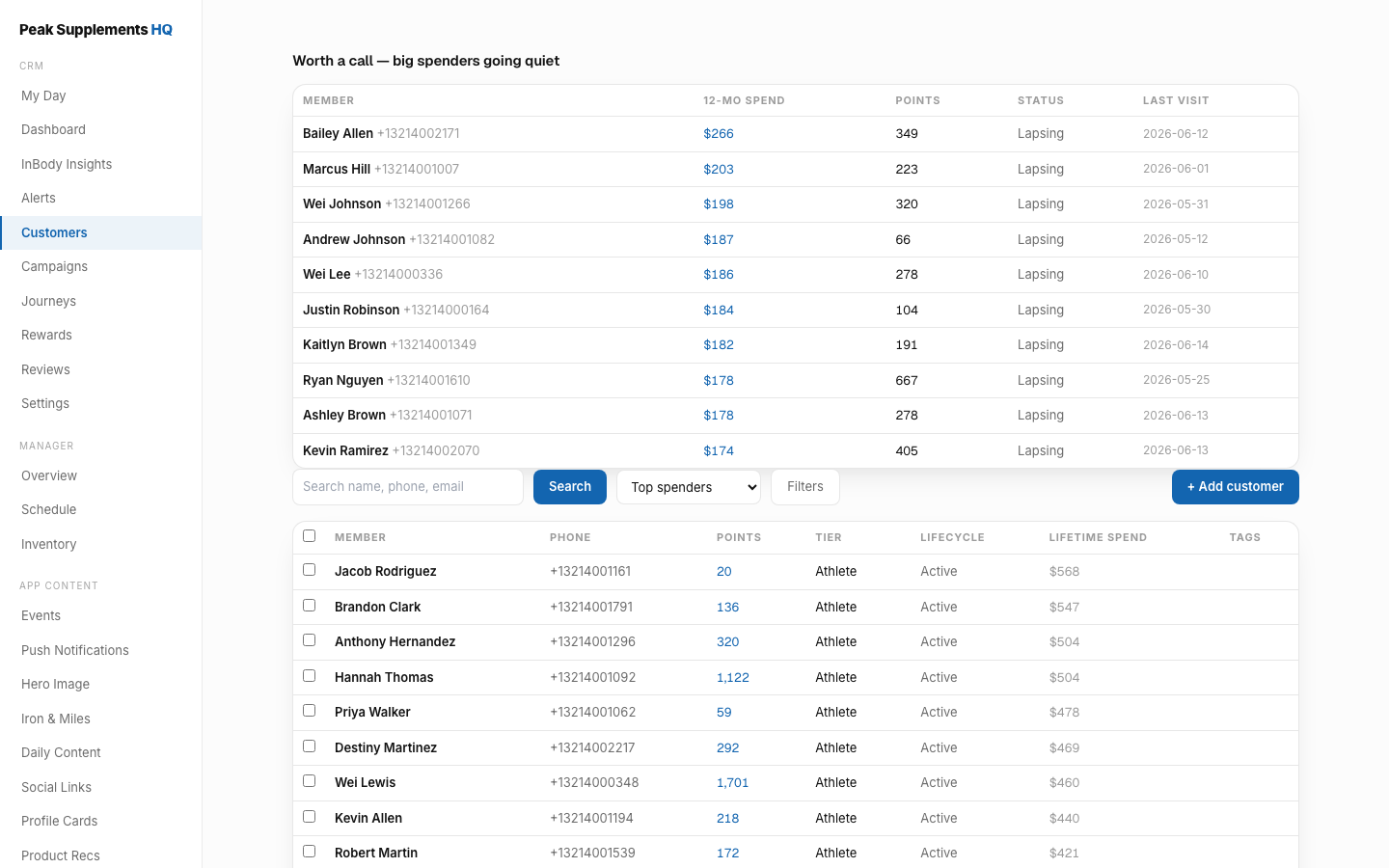
Someone whose ~30-day tub is at day 40 hasn't left — they're buying somewhere convenient or just drifting. One text with their points balance as the hook: “Hey — your 340 pts are sitting here, and they're $10 off a restock this week.” Concrete, personal, time-boxed. In our stores this is the single best-performing campaign, and it's why we compute lapsing automatically in the platform instead of leaving it to a spreadsheet nobody reruns.
Lost: one honest attempt, then leave them alone
A single win-back with your best reasonable offer. If it doesn't land, stop — continued texting of lost customers is how complaint rates rise and filtering starts. A clean list beats a big one.
Two cross-cutting segments worth the effort
- Category buyers. “Preworkout buyers, 30+ days quiet” gets a preworkout message, not a generic one. Requires purchase data on the member record — the reason POS integration matters beyond points.
- Top spenders. Your top decile funds the store. They get early access and first-name treatment, not coupons.
Budget reality
Segmented campaigns are also how a texting budget stays sane: four small, targeted sends beat one full-list blast on revenue and cost. The arithmetic — segments, message length, what 5,000 included texts covers — is in the budget post.
Start this week, even manually: pull last-visit dates, mark everyone 40–70 days quiet, and send the lapsing message. That one segment usually pays for the whole program.
Copy that fits each stage (steal these)
All GSM-7, all one segment, opt-out line included:
- New (day 4): “Hey Sam — welcome to the club. You're at 75 pts; 100 unlocks a free shaker. Reply STOP to opt out.” (108 chars)
- Active (tier-up): “Sam, you just hit Gold — points now earn 1.5x on everything. Nice work. Reply STOP to opt out.” (95 chars)
- Lapsing (day ~42): “Sam — your 340 pts are worth $10 off a restock this week. We'll have it ready. Reply STOP to opt out.” (102 chars)
- Lost (one shot): “Sam, been a while. Your points are still here — this week they're worth $15 off anything. Reply STOP to opt out.” (113 chars)
Notice what none of them do: shout in caps, stack emoji, or link anywhere. The offer is the store; the counter closes it.
Cadence rules that keep the list healthy
- Frequency caps: actives max 2 marketing texts/month; lapsing get their win-back and then silence until they act; lost get one message ever per campaign cycle. More volume ≠ more revenue; it equals more STOPs.
- Every message from a segment, none from “All.” Full-list sends are for genuine store news (moving, holiday hours) — twice a year, not twice a month.
- Let stages do the scheduling. The win-back should fire because that member hit day 42, not because it's the 1st of the month. Automated lifecycle triggers send fewer messages at better moments — which is precisely what keeps complaint rates down and carriers friendly.
- Review STOP rates per campaign, not per month. One message with an outlier opt-out rate is telling you something specific. Listen per-send.
And revisit the stage definitions twice a year. If you add a new category with a different cycle — say, single-serve energy drinks that people buy weekly — your lapsing thresholds need to know, or your fastest-cycle customers will look permanently active while quietly churning.