Feature
Know who's lapsing before they're gone.
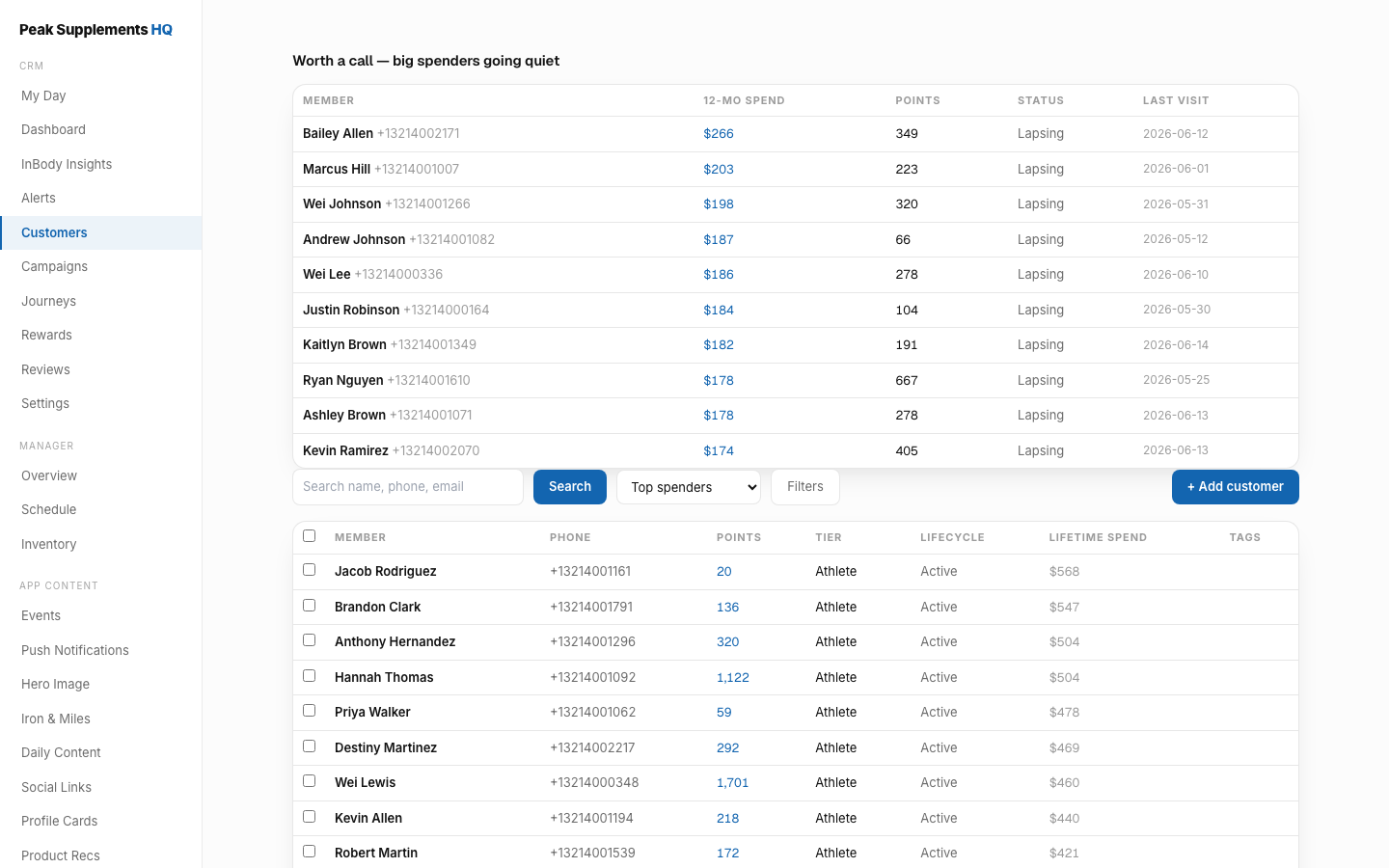
“Blast the whole list” is how loyalty texting dies. Every member in Eco Systems sits in a lifecycle stage — new, active, lapsing, lost — computed from their actual visit and purchase cadence, so campaigns target the members whose behavior calls for them.
01 — How it works
Segments computed from behavior, not built in spreadsheets
Stages update themselves as members shop; your campaigns just point at them.
- Lifecycle stages, automaticNew, active, lapsing, lost — defined by reorder cycles (a ~30-day tub, a ~6-week preworkout), not arbitrary calendar flags.
- Category and spend slices“Preworkout buyers, 30+ days quiet” is two clicks. Top-decile spenders get first-name treatment, not coupons.
- Campaigns aim at segmentsThe win-back fires because that member hit day 42 — not because it's the first of the month.
- Lifecycle analyticsWatch members move between stages month over month; catch a retention problem while it's cheap to fix.
- Fed by every capture pointKiosk check-ins, Shopify orders, and POS sales all land on one member record — so stages reflect reality.
02 — In practice
Four stages, four messages — that's the whole playbook
Segmentation only earns money when it changes what you send. Our operating playbook is public: what to text each lifecycle stage — the welcome that converts a first visit into a second, the tier-up note that protects your actives' margin, the day-42 win-back that is the single best-performing campaign in our own stores, and the one honest attempt a lost customer gets before you leave them alone.
Targeted sending is also a deliverability strategy: four small campaigns beat one blast on conversion and complaint rate, and complaint rate is what carriers grade your number on. The segments feed straight into SMS campaigns with drip sending and quiet hours built in — and because purchase data flows from Shopify, category segments actually know what people buy.
One habit to steal even if you never buy software: define "lapsed" in days-past-expected-reorder, not days-since-visit. A weekly energy-drink buyer who's been quiet for three weeks is further gone than a monthly protein buyer quiet for the same three weeks. Cycle-relative stages are the difference between a win-back that feels psychic and one that feels like spam — and they're why we compute stages per member, per category, instead of one global inactivity flag.
03 — Questions
Straight answers.
Do I have to build segments myself?
The lifecycle stages ship computed out of the box, tuned to consumable reorder cycles. Category, spend, and tier slices are point-and-click on top of them. You can be sending a lapsing win-back the week you go live.
What data do the segments use?
Kiosk check-ins, Shopify online and POS orders, reward redemptions, and tier status — all on one member record per person. No exports, no spreadsheet joins.
04 — Next step
See it running before you buy it.
Book a 20-minute demo — the portal, the kiosk, a real campaign send, and exactly what migrating your store would look like.
$200/mo platform · 5,000 texts included · no contracts